
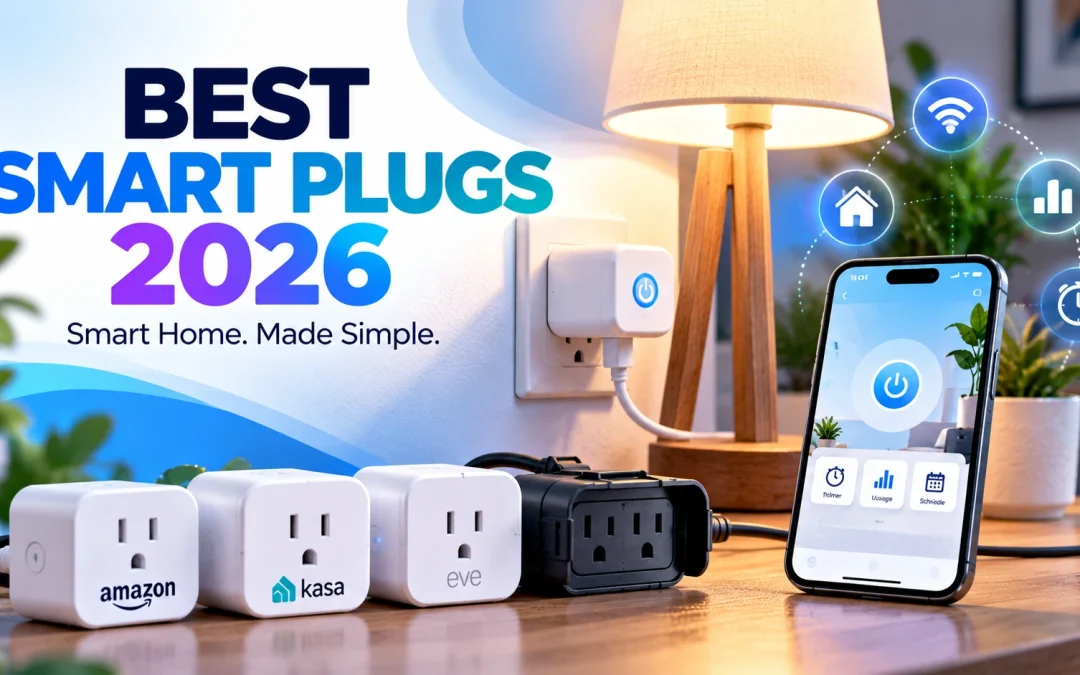
A smart plug remains one of the cheapest, fastest entry points into home automation, turning any existing lamp, fan, or appliance into a schedulable, remotely controllable device without needing to replace the appliance itself. The category has matured considerably in 2026, with widespread Matter standard support finally making cross-brand compatibility a non-issue, alongside genuinely useful energy monitoring that helps track exactly which devices are actually driving up an electricity bill. Here’s how this year’s strongest options compare.
Amazon Smart Plug
The Amazon Smart Plug remains one of the simplest, most affordable entry points into outlet automation, offering reliable Alexa voice control and app-based scheduling at a genuinely low price point that makes buying several for an entire home an easy decision. Its compact design doesn’t block an adjacent outlet the way some bulkier smart plugs do, a small but genuinely practical detail for anyone plugging multiple devices into the same power strip. For Alexa households specifically wanting the most budget-friendly way to add basic remote control and scheduling to several outlets at once, it remains one of the clearest default choices.


TP-Link Kasa Smart Plug
TP-Link’s Kasa Smart Plug lineup remains a genuinely strong all-around choice, offering broad compatibility with Alexa, Google Assistant, and Apple HomeKit simultaneously rather than locking a buyer into a single ecosystem. Its energy monitoring variants track real-time power consumption for a connected device, giving genuinely useful data on exactly how much a specific appliance actually costs to run over a month. Its well-designed app supports away mode, which randomly toggles connected devices on and off while a household is traveling to make a home look occupied, a genuinely practical security feature beyond pure convenience.
Eve Energy
Eve Energy stands out specifically for privacy-conscious Apple Home users, built natively around Matter and Thread with no cloud account required at all, meaning automation and control happen entirely locally without routing commands through an external server. Its built-in energy monitoring displays consumption directly within the Apple Home app, and its Thread radio support means it can also function as part of a broader Thread mesh network, extending smart home connectivity to other nearby Thread devices. For privacy-focused Apple households specifically, it remains one of the cleanest, most locally-controlled smart plug options available.
GE Cync Outdoor Smart Plug
The GE Cync Outdoor Smart Plug fills a genuine gap that most indoor-rated smart plugs leave open, offering a weatherproof design specifically built for controlling outdoor holiday lights, patio fans, or exterior water features safely exposed to rain and temperature swings. Its dual-outlet design lets two separate outdoor devices be controlled independently from a single unit, and its scheduling and voice control work through the same major assistant ecosystems as most indoor smart plugs. For anyone who specifically wants to automate an outdoor lighting or appliance setup without risking a plug not rated for outdoor exposure, it remains one of the more purpose-built options available.
Choosing between these four largely comes down to existing ecosystem and specific use case rather than any single universally superior pick. Alexa households wanting the simplest, most affordable indoor entry point should default to the Amazon Smart Plug, while anyone wanting broad cross-ecosystem compatibility and genuine energy monitoring should invest in TP-Link’s Kasa lineup. Privacy-focused Apple Home users should prioritize Eve Energy’s local-only Matter and Thread architecture, and anyone specifically automating outdoor lights or appliances should look to the GE Cync Outdoor Smart Plug rather than risking an indoor-only unit outside.
Conclusion
Smart plugs remain one of the most genuinely cost-effective upgrades in home automation, delivering real scheduling, remote control, and in some cases energy insight without requiring any permanent electrical work. Whichever of these four ends up fitting a household’s existing ecosystem and specific outlet, the underlying payoff remains the same: an ordinary appliance turned into something that runs on a schedule without anyone needing to remember to flip a switch.