
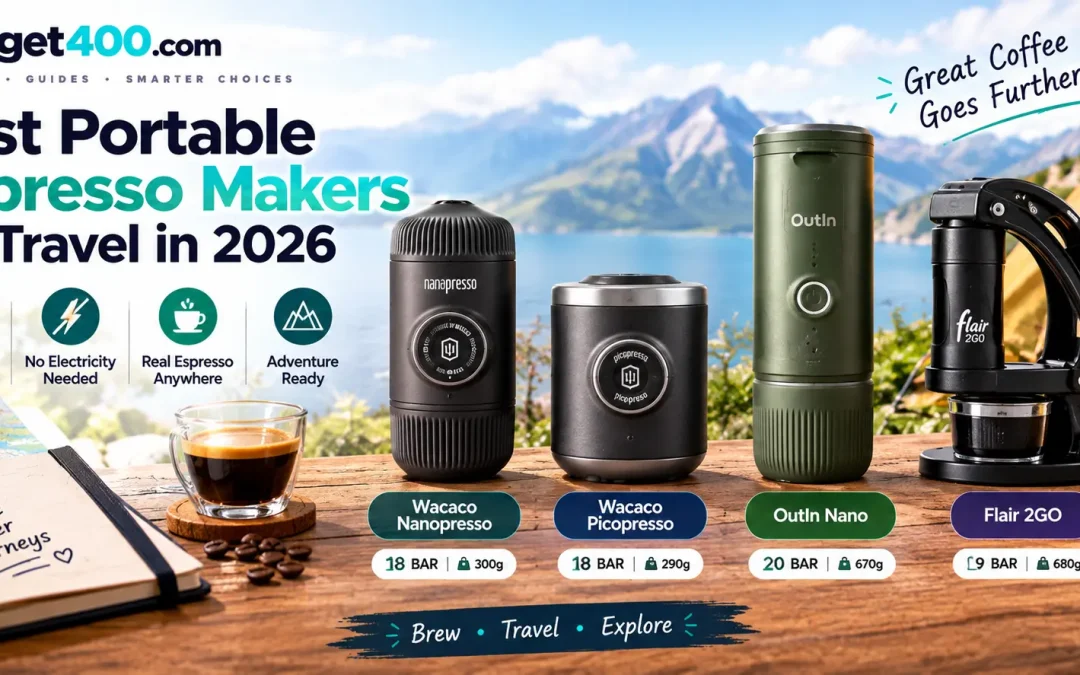
A portable espresso maker turns travel, camping, hotel rooms, and office desks into places a real shot of espresso is actually possible, no $1,000 countertop machine required. The category spans everything from $50 hand-pumped gadgets to $130 self-heating battery units, and the cheaper, no-name options can genuinely disappoint, making brand reputation and independently tested pressure ratings worth paying attention to before buying. Here’s how 2026’s strongest options compare on pressure, portability, and ease of use.
Wacaco Nanopresso
The Wacaco Nanopresso remains the model that made portable espresso mainstream, delivering up to 18 bars of pressure, well above the roughly 9 bars real espresso actually needs, entirely through a hand-pumped piston with no electricity or batteries required. Weighing just over 300 grams and measuring around six inches, it fits easily into a backpack or even a jacket pocket, and its pressurized filter basket means pre-ground coffee works fine, removing the need for a dedicated fine-grind grinder. At roughly $65 to $75, it remains the benchmark recommendation for most travelers, more forgiving for beginners than its pricier sibling while still delivering genuinely credible espresso.
Wacaco Picopresso
The Wacaco Picopresso is widely regarded as the closest thing to genuine café-quality espresso that fits in a jacket pocket, using a 51mm naked portafilter that holds roughly 18 grams of finely ground coffee for a true double shot with dense, authentic crema. It ships with a dosing funnel and distribution tool, mirroring the actual workflow of a real espresso machine, which rewards practice and technique rather than hiding operator mistakes the way a more forgiving pressurized basket does. At around $130, it commands a real premium over the Nanopresso, but for travelers who genuinely refuse to compromise on shot quality, it remains the category benchmark.
OutIn Nano
The OutIn Nano stands apart as the leading self-heating electric option, heating room-temperature water to roughly 198°F in about 200 seconds using a rechargeable battery, then driving extraction at up to 20 bar without requiring an external hot water source at all. Its one-button operation and USB-C charging compatibility make it a particularly strong fit for road trips and car camping, where convenience matters more than the absolute lightest possible pack weight, and it accepts both ground coffee and NS-style capsules for added flexibility. The tradeoff is genuine added weight and the need to keep it charged, but for anyone who wants espresso without carrying a separate kettle, it remains the clearest convenience-first pick.
Flair 2GO
The Flair 2GO trades a hand pump for a collapsible lever mechanism that delivers a smooth, controllable pressure curve, the same underlying principle behind Flair’s larger, more established home espresso machines, packed into a genuinely compact travel case. This lever-based extraction gives more experienced users finer control over the pressure profile throughout a shot compared to a simple hand-pump piston, appealing specifically to espresso enthusiasts who already understand and want to fine-tune their extraction technique. For travelers who want home-machine-level control in a genuinely packable form factor, it remains one of the more technically capable options in this category.
Choosing between these four largely comes down to how much technique, weight, and cost a traveler is willing to accept in exchange for shot quality. Beginners and most casual travelers should start with the Wacaco Nanopresso for its forgiving, pre-ground-friendly design and reasonable price, while genuine espresso enthusiasts who want the closest thing to café quality should invest in the Picopresso and be willing to practice the technique it demands. Road trippers and car campers who prioritize convenience over absolute lightest weight will get the most value from the OutIn Nano’s self-heating design, and experienced users who want finer pressure control should look toward the Flair 2GO’s lever-based extraction. A compact manual coffee grinder, such as a 1Zpresso or Kingrinder model, pairs well with any of these for a fully off-grid setup when pre-ground coffee isn’t an option.
Conclusion
Portable espresso makers have matured into genuinely capable travel gear, no longer a compromise but a real way to pull an authentic shot anywhere a bit of hot water and ground coffee can be found. Whichever of these four ends up fitting a specific travel style and coffee standard, the underlying payoff remains the same: no more rolling the dice on hotel-room coffee or settling for whatever’s available at a rest stop.