
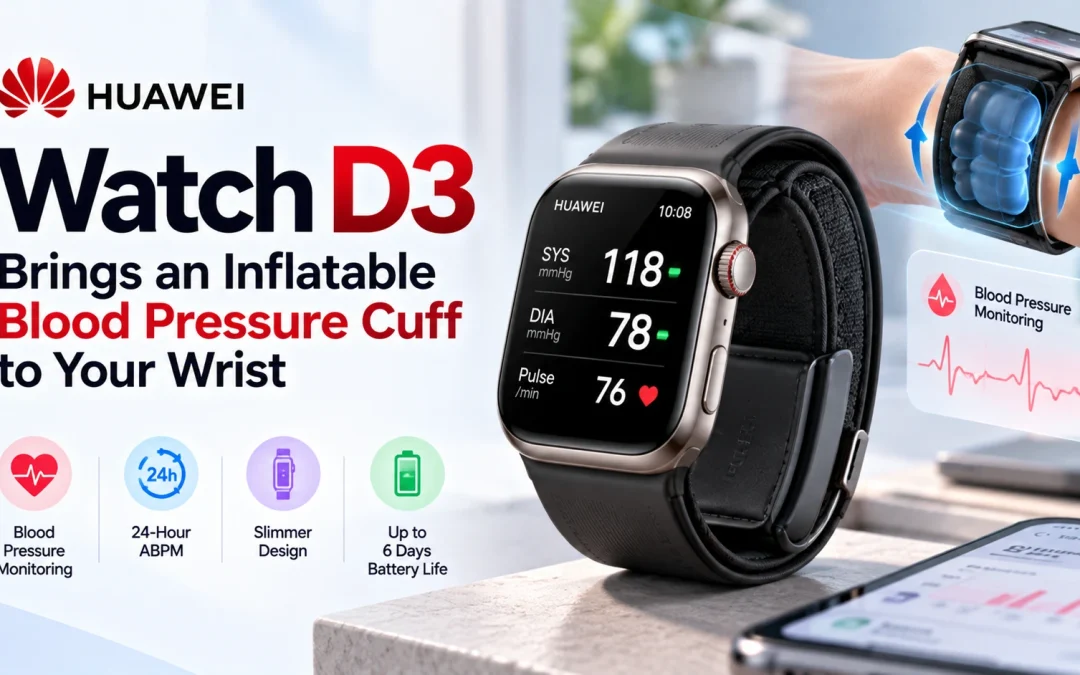
Huawei’s Watch D3 puts an unusual piece of hardware inside a familiar gadget: an inflatable blood pressure cuff built into a smartwatch strap. Announced in September 2026, the device arrives at a reported UK price of £399.99, positioning it as a premium wearable with a specific health-monitoring focus.
Its appeal is easy to understand. A watch already travels with its owner throughout the day. Adding blood pressure measurements could make recording that information more convenient. However, the D3 also highlights the questions that matter when a consumer gadget takes on health-related responsibilities: how measurements work, what affects them, and how much confidence users should place in the results.
How the Built-In Cuff Works
Huawei says the Watch D3 uses an inflatable mechanical airbag and a pressure sensor to measure blood pressure through the oscillometric method. It also supports a 24-hour ambulatory blood pressure monitoring plan, known as ABPM, with reports available through the Huawei Health app.
The important distinction is the measurement hardware. The strap physically inflates around the wrist, making the cuff part of the wearable itself.
That integration is the most interesting aspect of the D3. Rather than asking users to carry another device, Huawei has incorporated a specialised measurement system into something intended for everyday wear. Whether that convenience translates into a useful routine will depend on how comfortably it fits into the owner’s day.
A Slimmer Body, With a Specification Caveat
Huawei lists a 1.92-inch AMOLED display and a watch-body weight of approximately 40 grams without the strap. The quoted thickness is 11.3mm, measured at the thinnest point and excluding the sensor area. That qualification matters when judging how compact the watch actually is.
Comfort becomes particularly relevant for a device designed to collect information overnight. A specification sheet can describe dimensions, but it cannot tell every buyer whether the case and inflatable strap will feel comfortable during sleep.
Early reviews also illustrate how subjective wearability can be. TechRadar found that the revised design still presented comfort issues, despite improvements over the previous model.
Battery Life Depends on the Main Feature
Huawei claims up to six days of battery life under its typical-use test conditions. With ABPM enabled, that figure falls to approximately one day. Both estimates come from Huawei’s laboratory testing, and actual endurance will vary with usage.
This is a significant distinction for prospective buyers. Someone taking occasional measurements may have a very different charging routine from someone running a full monitoring session.
The six-day headline therefore needs context. Buyers interested primarily in blood pressure tracking should look at the battery estimate for that mode, rather than assuming every feature can run continuously for nearly a week.
Automatic Scheduling Still Requires Cooperation
Scheduled measurements do not eliminate the need to use the device correctly. Huawei’s guidance calls for appropriate positioning, including keeping the device at heart level and remaining still during measurements. Correct strap and airbag sizing also matter.
T3’s reviewer reported missing some daytime readings while occupied with other activities. That observation helps explain the practical limitation: a monitoring schedule may be automatic, but the wearer still needs to cooperate when a reading is taken.
For people with busy working days, that could be more important than another workout mode or a brighter screen. A useful health gadget needs a measurement routine that its owner can realistically follow.
Early Accuracy Findings Need Context
In its review, T3 reported consistently lower blood pressure readings from the Watch D3 than from a Garmin Index BPM upper-arm monitor. The reviewer also stressed that this was a small, nonclinical comparison and did not establish that the Huawei device was universally inaccurate.
The finding deserves attention without being overstated. It raises a question for further testing, rather than providing a final verdict on every unit or user. Huawei itself says the product’s readings should not be used as the basis for medical diagnosis or treatment.
A Distinctive Wearable With Practical Trade-Offs
The Watch D3 is an interesting example of specialised hardware becoming part of an everyday gadget. Its strongest story is the integration of an inflatable cuff into a wearable format.
For buyers, the decision should centre on that feature: its measurement process, comfort, charging demands and usefulness. The D3 offers a compelling design idea, but its real value will come from dependable measurements and a routine people can sustain.
Sources

- [Huawei Watch D3 — official features and usage guidance]
- [Huawei Watch D3 — official specifications]
- [T3 — Huawei Watch D3 review, September 23, 2026]
- [TechRadar — Huawei Watch D3 review]