
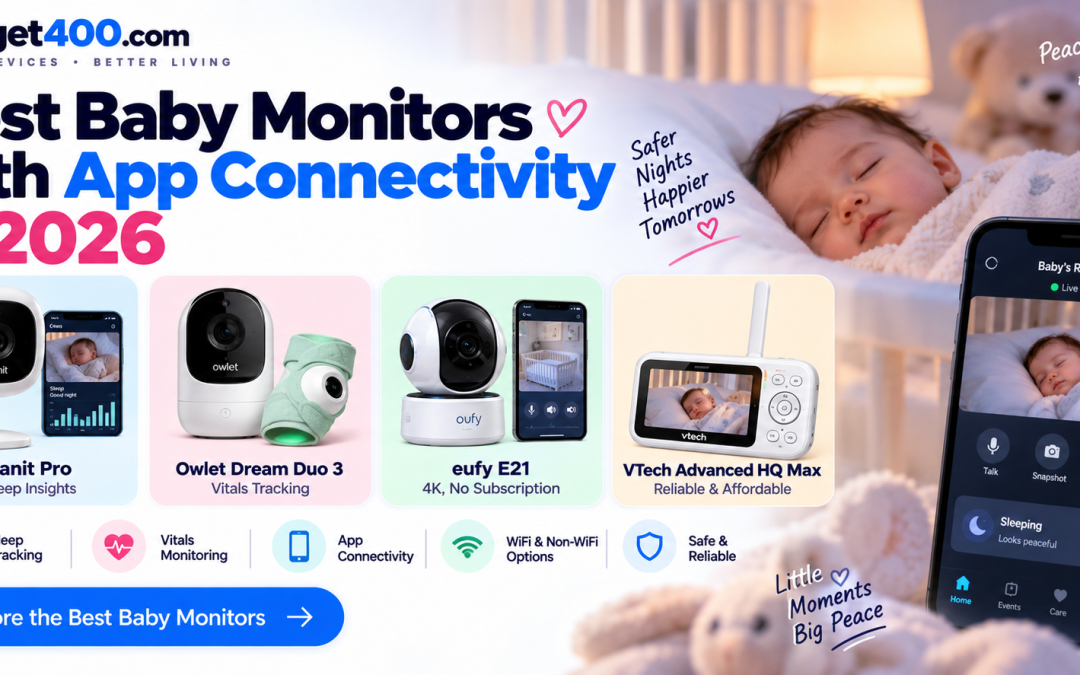
Smart baby monitors have grown considerably more capable in 2026, adding sleep analytics, vitals tracking, and AI-powered alerts that go well beyond a simple video feed, but that added sophistication almost always comes bundled with a recurring subscription fee that’s worth understanding before buying. It’s also worth knowing that safety recalls remain a real concern in this category: roughly 81,800 units of a popular baby monitor were recalled in February 2026, a reminder to register any purchased device and stay alert to manufacturer safety notices. Here’s how 2026’s strongest options compare.
Nanit Pro
The Nanit Pro remains the most data-rich option in the category, using computer vision to track sleep patterns and generate genuinely detailed nightly reports showing exactly when a baby fell asleep, stirred, and woke, alongside personalized coaching to help address specific sleep regressions. Its picture quality sits at 1080p, noticeably softer side by side against some 2K and 4K competitors, a real tradeoff for the price. The genuinely useful sleep analytics and coaching live behind a subscription running roughly $5 to $30 a month depending on tier, which adds up to $420 to $780 over two years, worth it specifically for parents who will actually use the data to troubleshoot nap schedules rather than glance at it occasionally.
Owlet Dream Duo 3
The Owlet Dream Duo 3, bundling the Dream Sock wearable with a 2K Dream Sight camera at $379.99, remains the only FDA-cleared over-the-counter baby monitor tracking pulse rate and oxygen saturation in real time, with clinical validation across skin tones and Health Notifications alerting parents if readings leave preset safe ranges. This makes it the clear choice specifically for parents who want genuine medical-grade vitals monitoring rather than video and sleep tracking alone, a meaningfully different value proposition from every other monitor on this list. Its price reflects that added medical-grade capability, positioning it firmly at the premium end of the category for parents who specifically prioritize vitals data.
eufy E21
The eufy E21 has emerged as the strongest subscription-free pick in the category at $259.99, delivering 4K video quality with 330-degree pan and 110-degree tilt for genuinely comprehensive room coverage without ever requiring an ongoing monthly fee for full feature access. Its non-invasive infrared night vision and sound and temperature detection cover the practical essentials most parents actually need, and its one-time cost model appeals directly to buyers who specifically refuse to pay recurring fees for baby monitor features. For parents who want reliable, high-resolution video and basic smart alerts without ever thinking about a subscription again, it remains one of the clearest value picks available.
View on Play Store | View on App Store
VTech Advanced HQ Max
The VTech Advanced HQ Max represents the strongest budget, non-WiFi option, using a closed, encrypted FHSS radio link rather than an internet connection, which means it simply cannot be hacked remotely the way a WiFi-connected monitor theoretically could. For parents whose primary concern is a fast, reliable picture without any app, cloud account, or ongoing fee whatsoever, its dedicated screen delivers exactly that: glance at the screen, confirm the baby is asleep, and move on, without unlocking a phone or waiting for an app to connect. At under $50, it remains the most budget-friendly reliable pick in the entire category, trading remote phone viewing for genuine simplicity and privacy.
Choosing between these four largely comes down to how much data-driven insight actually matters relative to cost and privacy preference. Parents who genuinely want detailed sleep analytics and are willing to use that data to fix nap schedules should invest in the Nanit Pro despite its subscription, while anyone specifically concerned about a baby’s breathing or oxygen levels should prioritize the Owlet Dream Duo 3’s FDA-cleared vitals tracking. Budget-conscious parents who want a reliable picture without recurring fees should default to the eufy E21 for WiFi connectivity or the VTech Advanced HQ Max for a fully offline, subscription-free experience. Whichever monitor gets chosen, registering the product with the manufacturer remains worth doing given the category’s real history of safety recalls.
Conclusion
Baby monitors have grown genuinely smarter in 2026, but that added sophistication comes with real tradeoffs worth weighing honestly, particularly around ongoing subscription costs and whether a WiFi connection or a closed, private radio link better fits a family’s comfort level. Whichever of these four ends up being the right fit, the underlying goal remains the same: a little more peace of mind during the hours a baby sleeps without a parent watching directly.