
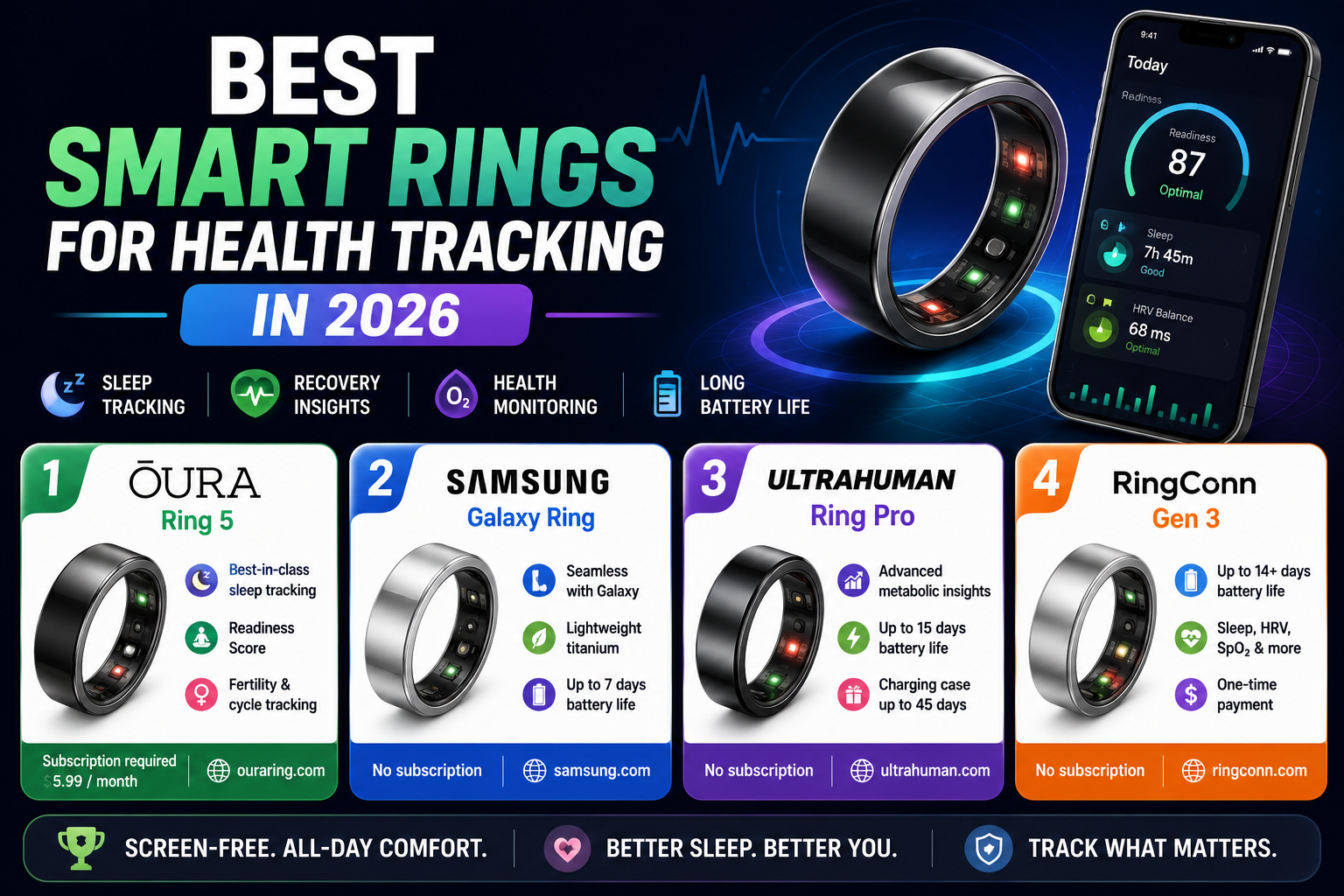
Smart rings have carved out a genuine niche apart from smartwatches by offering the same core health metrics, sleep staging, heart rate variability, recovery scoring, in a package small and unobtrusive enough that most wearers forget they have it on. The category has matured considerably in 2026, with hardware shrinking further, battery life stretching well past a week on several models, and a real divide opening up between premium subscription-backed rings and increasingly capable subscription-free alternatives. Choosing between them mostly comes down to how much a buyer is willing to pay monthly for deeper insights versus getting full functionality baked into the upfront hardware cost. Here’s how the leading options stack up this year.
Oura Ring 5
Oura Ring 5 remains the undisputed benchmark for sleep-staging precision and long-term health insight in 2026, with hardware components shrunk by 40 percent compared to earlier generations to produce an ultra-slim ring that feels closer to ordinary jewelry than a piece of health tech. Its readiness score, which synthesizes sleep quality, recovery, and activity into a single daily number, remains the most trusted feature in the category, and its fertility and cycle tracking are considered best-in-class among wearables generally. The tradeoff is a required Oura Membership, priced around $5.99 a month or $69.99 a year, without which the ring’s deeper insights and most historical data remain locked behind the subscription.
Samsung Galaxy Ring
The Samsung Galaxy Ring integrates directly and seamlessly with Samsung Health on Galaxy phones, making it the natural pick for anyone already embedded in Samsung’s device ecosystem who wants ring-based tracking without adding a separate app or subscription. Its lightweight titanium build and roughly seven-day battery life keep it comfortable for continuous wear, and an early-2025 sizing update expanded its available range to sizes 5 through 15, addressing a common early complaint about limited fit options. Because it functions purely as an extension of Samsung Health rather than a standalone platform, it works best for Android and specifically Galaxy device owners rather than as a cross-platform choice.
Ultrahuman Ring Pro
Ultrahuman’s Ring Pro has emerged as a genuinely strong Oura rival in 2026, following the resolution of an earlier US patent dispute with Oura that had temporarily pulled Ultrahuman products from sale. The Ring Pro focuses heavily on metabolic health, recovery tracking, and circadian rhythm insights, all delivered without a required monthly subscription, and claims category-leading battery life of up to 15 days on the ring itself and up to 45 days when paired with its charging case. For buyers who want Oura-level metric depth without an ongoing membership fee, it has become one of the most compelling alternatives on the market this year.
RingConn Gen 3
RingConn Gen 3 has built its reputation specifically around battery life and straightforward, subscription-free operation, often stretching beyond 14 days on a single charge thanks to efficient power management, well ahead of most competitors in this category. It covers the core metrics most buyers actually want, sleep staging, heart rate variability, blood oxygen, and recovery scoring, without gating any of it behind a monthly fee, at a confirmed hardware price of $299. For buyers whose main priority is avoiding recurring costs while still getting genuinely useful sleep and recovery data, RingConn remains one of the most straightforward picks in the category.
The decision between these four rings really comes down to one core question: how much value does a buyer place on Oura’s more polished software and deeper longitudinal insights against a recurring subscription fee. Oura remains the safest premium pick for anyone who wants the most mature app experience and is comfortable paying for it, while RingConn, Ultrahuman, and the Samsung Galaxy Ring all deliver strong core health tracking with no required ongoing cost. Samsung’s ring makes the most sense specifically for existing Galaxy phone owners, while RingConn and Ultrahuman work across both iOS and Android, making them the more flexible subscription-free choices for anyone not locked into Samsung’s ecosystem.
Conclusion
Smart rings have moved from a niche curiosity to a genuinely mainstream way to track sleep and recovery without the bulk of a smartwatch on the wrist, and 2026’s lineup offers real, meaningful choice between subscription and subscription-free approaches. Whichever ring ends up being the right fit, the category has clearly reached a point where the core health data, not just the form factor, is good enough to change how people actually think about their sleep and recovery.