When Samsung launches a new Galaxy phone, nobody expects them to just list it on their website and wait. There is a press embargo. A launch event. A media briefing. Review units sent to journalists six weeks in advance. A coordinated global announcement on a single day. A press release that goes to every major tech publication simultaneously.
And then – and only then – the product goes on sale.
Android app developers are launching real products. Products with real users, real competitors, and real market windows that open and close. But most of them launch like they are posting a photo, not shipping a product – they push to the Play Store, send one tweet, and wait to see what happens.
The hardware world figured out Android app launch strategy and PR a long time ago. The principles do not change because the product is software instead of silicon. Here is the complete hardware launch playbook applied to Android apps – and how every developer, from solo indie to funded studio, can borrow it.
1. The Embargo Model – Control When the News Breaks
Hardware companies do not let reviews go live the moment a journalist receives a device. They set an embargo – a specific date and time when all coverage goes live simultaneously. Every review, every hands-on piece, every unboxing video drops at the same moment. The result is a coordinated wave of press on launch day that floods search results, social feeds, and tech news aggregators all at once. It creates the perception of an event, not a release.
App developers can run a scaled version of the same model – and it works just as well at indie scale as it does for a major studio launch.
Two weeks before launch day, share your app with a small, curated list of Android reviewers and tech bloggers under a simple embargo agreement. Give them your press release, a TestFlight or early access link, and your asset pack. Ask them not to publish before a specific date and time. Most reviewers respect this completely – it gives them time to write a thorough, considered review rather than a quick hit piece, and it gives you a coordinated launch moment instead of a slow, forgettable trickle.
The embargo does not require legal contracts for independent developers. A single clear line in your outreach email – “This is embargoed until June 10, 2026 at 9am IST” – is sufficient. Reviewers who break embargoes lose early access to future launches. The community enforces this norm without any action needed from you.
Gadget400’s coverage of Android app and gadget launches consistently shows that apps arriving with pre-launch review access and a clear embargo date receive more thorough editorial treatment than apps that appear without warning on a random Tuesday. The preparation signals that the developer has confidence in what they are launching.
2. The Press Kit – Your Hardware Box, Made Digital
Every premium gadget ships in packaging designed to be unboxed on camera. The box itself is a communication tool – it signals quality, attention to detail, and respect for the customer’s experience before the device is even switched on. That first impression shapes the review before a single feature is tested.
Your press kit is the digital equivalent of that box for your Android app press release and launch campaign.
A well-built press kit contains everything a journalist or gadget blogger needs to cover your launch without sending a single follow-up email. Host it permanently at a public URL – yourappname.com/press is the standard format – and keep it live long after launch day because coverage appears weeks and months after the initial release. The kit should include every one of the following:
- One-paragraph app summary written in third person – this is the boilerplate text that journalists paste directly into articles without editing. Write it once, write it well, and it saves both you and the reviewer significant time
- App icon at 1024×1024 PNG with a transparent background – this appears in every article header, every social share, and every app store roundup that features your launch
- Feature graphic at 1920×1080 – publication-ready, used as the hero image in the majority of editorial pieces about your app
- Screenshots at full resolution – minimum six, showing different features, screens, and use cases. Real UI from real sessions, not marketing mockups
- Founder or developer photo – headshot at minimum 800×800, needed for profile pieces and developer-focused coverage that gadget and tech publications regularly run alongside app launches
- Company or studio logo – light and dark versions, SVG format preferred for publication flexibility
- Press release – both PDF and plain text formats, because different publications have different requirements
- Play Store link and developer website URL – both clearly labelled and confirmed working
- Media contact email – a branded address, not a personal Gmail account. The credibility signal this sends is disproportionate to the effort required
The difference between a developer who receives editorial coverage and one who does not is frequently just the existence of this kit. Journalists cover what is easy to cover on a deadline. A complete, well-organised press kit removes every obstacle between your app and a published review.
3. The Press Release – Your Product Spec Sheet
Every major hardware launch comes with a detailed specification sheet. Not because consumers read every line – they do not – but because it is the authoritative reference document that journalists pull exact numbers and accurate claims from when writing reviews. The spec sheet eliminates errors and establishes the factual record of the product.
Your press release is exactly that document for your Android app launch.
It tells the press everything they need to write about your launch accurately: what the app is, who built it and who the intended user is, what specific problem it solves that existing apps do not, what its key specifications are (platform, price, minimum Android version, key permissions), and what makes it worth covering rather than the seventeen similar apps already in the Play Store. It includes a developer quote – the human voice behind the product, giving journalists the interview content they need without scheduling a call.
When that press release is published on a dedicated platform like androidnewswire.com, it becomes a permanently indexed, linkable reference document that any journalist, blogger, or aggregator covering your category can find through a simple search. It also generates topically relevant backlinks to your Play Store listing from within the Android content ecosystem – which carries measurable weight in Play Store search ranking. Submitting through a purpose-built App Launch Service takes that a step further, ensuring your release is structured and distributed in a way that maximizes editorial pickup and indexation across Android-focused channels. Hardware companies do not skip the spec sheet. App developers should not skip the press release.
Write it before launch day. Publish it before launch day. Let it get indexed and establish its presence in search before your Play Store listing goes live. Then launch into an environment where your app already has a documented public existence.
4. The Launch Window – Not a Day, a Week
Hardware launches are not single-day events and have not been for decades. The announcement happens on day one. Initial reviews go live on day one. But the coverage that builds lasting search presence – hands-on follow-up pieces, comparison articles, “one week with” reviews, buyer’s guide mentions – runs for the next 7 to 14 days. The hardware launch team plans for the entire window, not just the opening moment.
The same structure applied to an Android app launch looks like this:
Day 0 – Launch: Press release live and distributed. Play Store listing goes live. Social posts go out across every platform you maintain a presence on. Embargo lifts for the reviewers who received early access. Goal: concentrated, simultaneous coverage from multiple outlets hitting at the same moment.
Days 1 to 3 – Engagement: Respond to every early Play Store review personally and specifically – not with a template response, but with a reply that addresses the specific point the reviewer made. Engage with every social media mention. Share any editorial coverage you received. Goal: demonstrate an active, responsive developer presence that the Play Store algorithm and potential users both notice.
Days 4 to 7 – Secondary outreach: Pitch the outlets you did not reach before launch. Now you have live coverage and real early download data to reference in your pitch. “We launched on Monday, received coverage from [outlets], and have [X] downloads in the first 72 hours” is a significantly stronger pitch than “we are launching next week.” Goal: extend the editorial coverage window beyond the initial launch day spike.
Week 2 – Developer transparency: Publish a post-launch developer note – on your own site, on Medium, on Reddit’s relevant developer communities. Cover what you built, what you learned in the first week, what feedback surprised you, and what you are building next. This kind of genuine transparency consistently generates a second wave of coverage from tech and developer-focused publications and communities that find the behind-the-scenes narrative as interesting as the app itself.
Most apps receive one day of effort at launch. The apps that sustain download momentum through the first two weeks receive a sustained week of effort. The difference in outcome is measurable and consistent. Our ongoing coverage of Android app reviews demonstrates exactly this pattern – apps with structured launch campaigns generate editorial follow-up coverage; apps without them do not.
5. The Positioning Statement – Your Tagline on the Box
Every premium gadget has a tagline that travels. “The thinnest phone ever made.” “Pro camera. Everywhere.” “The chip that changes everything.” These lines exist because marketing teams know that a single memorable, specific phrase travels further through media coverage, social sharing, and word of mouth than any detailed feature paragraph.
Your app needs one. And it needs to be specific enough to be true and differentiated enough to be memorable.
Not a category description – not “a productivity app for Android” or “a photo editor with filters.” A positioning line that names the specific value your app delivers to a specific identifiable person in a specific situation:
- “Budget tracking that takes 10 seconds a day.”
- “The only offline-first note app with full Markdown export.”
- “Task management built for solo freelancers, not enterprise teams.”
- “Sleep sounds that adapt to your environment in real time.”
Each of these lines names who it is for, what it does differently, and why that difference matters – in under ten words. Put this line in your press release headline, your Play Store short description (the 80-character field that appears in search results), and every pitch email you send. Repetition across every touchpoint is how a positioning line becomes associated with your app in both human memory and search index.
The Hardware Launch Principles Applied to Android Apps
| Hardware World | Android App Equivalent | What It Achieves |
|---|---|---|
| Press embargo | Reviewer pre-access with a clear embargo date | Coordinated launch day coverage from multiple outlets simultaneously |
| Product packaging | Press kit at a permanent public URL | Easy coverage for journalists on deadline – removes every barrier to publication |
| Specification sheet | Press release on an indexed Android platform | Authoritative reference document plus topically relevant backlinks to Play Store listing |
| Coordinated launch event | Day 0 – Play Store live, press release live, social live simultaneously | Concentrated arrival of coverage rather than a slow trickle |
| Post-launch follow-up coverage | Developer transparency note plus secondary outlet pitching in Week 2 | Second wave of editorial coverage that sustains download momentum |
| Product tagline on packaging | Positioning statement in all launch copy | Memorable differentiation that travels through press coverage and social sharing |
The playbook already exists. Hardware companies built it over decades of product launches, refined it through billions of dollars of experience, and proved it works at every scale from a regional product launch to a global flagship release. Android app developers do not need to invent a new model. They need to borrow the one that is already proven – scaled to their resources, adapted to their platform, and executed with the same deliberateness the hardware world brings to every launch it considers important.
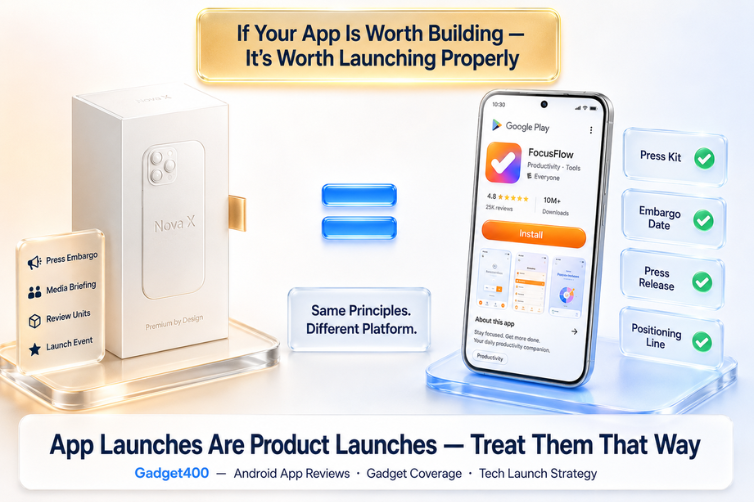
If your app is worth building, it is worth launching properly.
Frequently Asked Questions
Do indie Android app developers really need a press embargo?
Yes – at any scale where you are reaching out to more than one reviewer before launch. Without an embargo, reviewers who move fast publish immediately, which means your coverage trickles out one piece at a time over several weeks. With an embargo, even three or four reviewers publishing simultaneously on launch day creates the perception of a significant launch event rather than a random app appearing in the Play Store. The coordination itself has marketing value independent of the coverage volume.
What is the minimum viable press kit for a solo developer launching an Android app?
Five elements cover the minimum: app icon at 1024×1024 PNG, four to six full-resolution screenshots of real UI, a one-paragraph app summary in third person, your press release in plain text, and your Play Store link. Host these at a single shareable Google Drive or Dropbox URL and link to that URL in every outreach email. A solo developer who provides these five elements is better prepared than the majority of small-studio launches that arrive without any organised assets at all.
How important is the Play Store short description for app launch PR?
Very – for two reasons that compound each other. First, it is the 80-character text that appears in Play Store search results below your app name, which means it is what potential users read before they click through to your full listing. Second, it is often the text that editorial roundups and app discovery sites quote when they reference your app without using your full press release. Your positioning statement belongs here – specific, memorable, differentiated. “Budget tracking that takes 10 seconds a day” is a short description that does work. “A simple and easy-to-use personal finance app” does not.
When should the press release be published relative to launch day?
Seven to ten days before launch day is the optimal window. This gives the release time to be indexed by search engines before your Play Store listing goes live, which means journalists and bloggers who receive your pitch can verify your app’s existence and context with a simple Google search before they decide whether to cover it. A press release published on launch day has not been indexed yet and cannot serve this verification function. Publishing earlier than two weeks before launch risks the momentum fading before the Play Store listing is live.
Is the “developer transparency post” in Week 2 really worth the effort?
Consistently yes – for a specific reason. The developer-focused audience that reads “what I learned in my first week on the Play Store” content is different from the user audience that reads app reviews. Developer communities on Reddit, Hacker News, and Medium have their own editorial discovery mechanisms, and a genuine, honest post-launch developer note regularly gets significant traction in those communities. That traction generates a second wave of downloads from a tech-literate audience that tends to leave detailed reviews – which improves your Play Store review quality at a critical early moment in the listing’s algorithmic life.
Gadget400 covers Android hardware, mobile apps, gadget reviews, and tech launches. Got an app or gadget launch coming up? Check our submission guidelines and browse our recent reviews to see the standard we apply.